


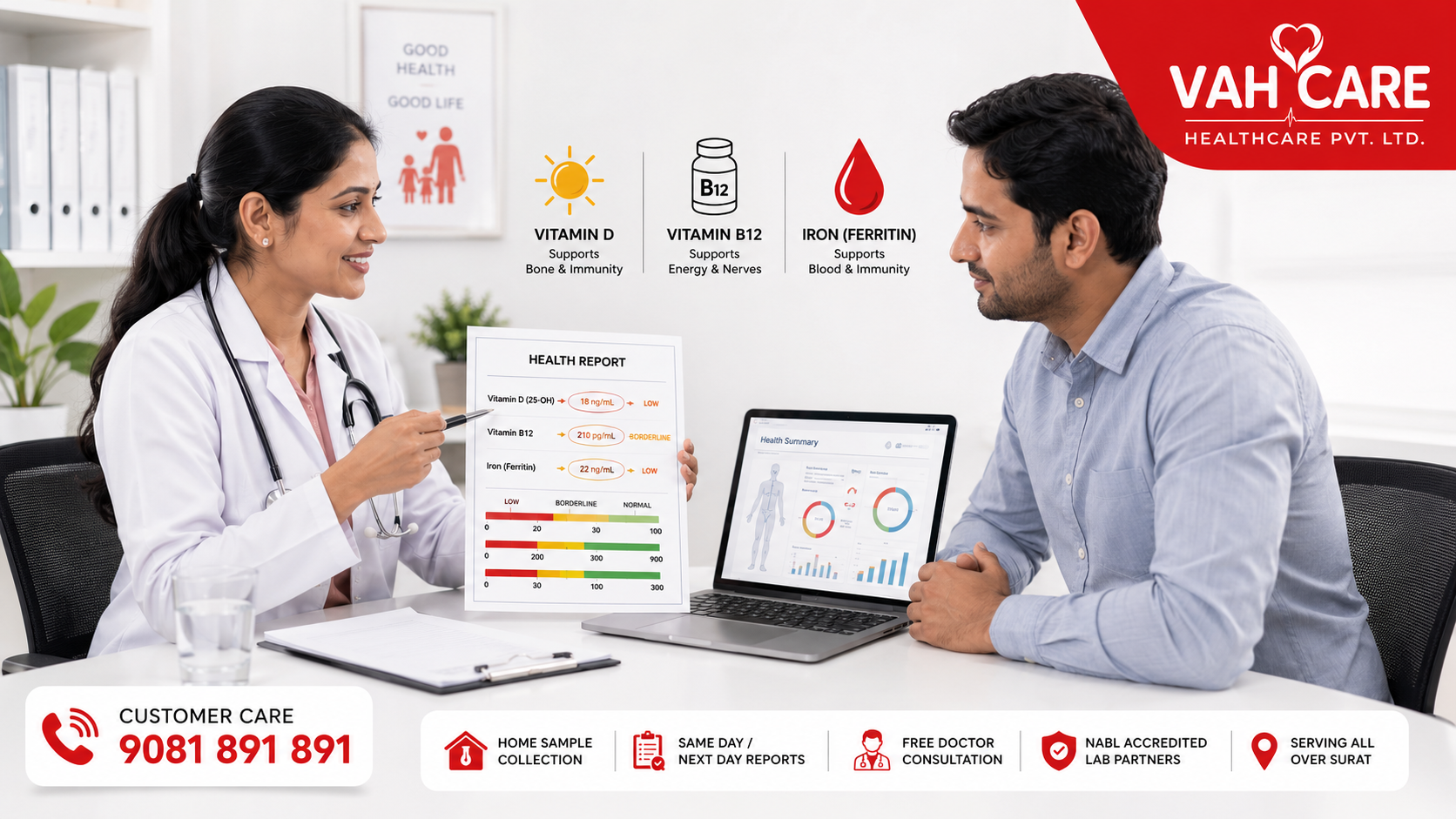
The Report Is Just the Beginning
Every day, thousands of Indians across Surat and across the country receive blood test reports that contain abnormal values — and have no clear understanding of what those values mean for their health.
A Vitamin D level of 12 ng/mL. A Vitamin B12 of 165 pg/mL. A serum ferritin of 7 ng/mL. These numbers, printed in red or flagged with an asterisk on a lab report, carry significant clinical meaning. But without the context to interpret them — what the normal range is, what symptoms the deficiency explains, how urgent the correction is, and what treatment looks like — the report becomes an anxiety-inducing document rather than a health tool.
This guide exists to change that. Written by the team at Vahcare Healthcare Pvt. Ltd., Surat, it is a plain-language, comprehensive explainer designed to help Indian families understand three of the most common and most clinically significant deficiencies revealed by routine blood tests: Vitamin D, Vitamin B12, and Iron.
India has among the highest rates of all three deficiencies in the world — driven by vegetarian diets, indoor lifestyles, poor soil mineral content, poor dietary diversity, and a healthcare culture that has historically focused on treating disease rather than detecting and correcting nutritional deficiencies before they cause harm.
Understanding your report is the first step. Knowing what to do with it is the second. And making sure your next report shows improvement is what Vahcare's home sample collection, same-day reports, and doctor consultation service in Surat makes possible.
Why These Three Deficiencies Matter So Much
Before diving into the numbers, it helps to understand why Vitamin D, Vitamin B12, and Iron deserve special attention in the Indian health context.
Scale of the problem: Studies consistently find that over 70% of urban Indians are Vitamin D deficient, that Vitamin B12 deficiency affects the vast majority of vegetarian adults over time, and that iron deficiency anaemia is the world's most prevalent nutritional deficiency — with Indian women of reproductive age among the most affected populations globally.
Symptom overlap: All three deficiencies share a common set of symptoms — fatigue, weakness, cognitive difficulties, and mood disturbances — that are easily attributed to lifestyle stress rather than nutritional insufficiency. This overlap makes them simultaneously ubiquitous and underdiagnosed.
Silent progression: Each deficiency develops slowly and silently. A person can lose 70–80% of their Vitamin D stores, see their B12 drop to a fraction of normal, or deplete their iron reserves significantly before symptoms become impossible to ignore.
Serious consequences when untreated: Left uncorrected, these deficiencies cause conditions ranging from osteoporosis and nerve damage to severe anaemia and cardiac complications — all of which are entirely preventable with timely detection and appropriate supplementation.
Easy to detect and treat: Unlike many serious conditions, all three deficiencies are detected through straightforward blood tests and corrected through supplementation, dietary change, and lifestyle modification. There is no reason for anyone to suffer the consequences of undetected deficiency.
Part One: Understanding Your Vitamin D Report
What Is Vitamin D and Why Does It Matter?
Vitamin D is not just a vitamin — it functions as a hormone, regulating over 200 biological processes in the human body. Its most well-known role is regulating calcium and phosphorus absorption, which is essential for bone mineralisation and density. But its functions extend far beyond bone health:
- Immune regulation: Vitamin D activates immune cells and regulates inflammatory response. Deficiency is associated with increased susceptibility to respiratory infections, autoimmune conditions, and impaired recovery from illness.
- Cardiovascular health: Low Vitamin D is independently associated with elevated blood pressure, endothelial dysfunction, and increased cardiac event risk.
- Mood and mental health: Vitamin D receptors are present throughout the brain. Deficiency is strongly linked to depression, anxiety, and seasonal mood changes.
- Muscle function: Vitamin D is essential for muscle contraction and strength. Deficiency causes muscle weakness and increases fall risk, particularly in elderly individuals.
- Cancer risk modulation: Emerging evidence associates adequate Vitamin D with reduced risk of several cancers, including colorectal, breast, and prostate cancer.
- Insulin sensitivity: Low Vitamin D impairs insulin signalling, worsening blood sugar control and contributing to Type 2 diabetes risk.
How to Read Your Vitamin D Report
Your report will show 25-Hydroxyvitamin D (25-OH Vitamin D), measured in either ng/mL (nanograms per millilitre) or nmol/L (nanomoles per litre). Most Indian laboratories report in ng/mL.
Reference ranges (ng/mL):
| Level | Value | What It Means |
|---|---|---|
| Severely deficient | Below 10 ng/mL | Urgent correction required; significant health risk |
| Deficient | 10–19 ng/mL | Clinically deficient; supplementation essential |
| Insufficient | 20–29 ng/mL | Below optimal; supplementation recommended |
| Optimal / Normal | 30–80 ng/mL | Target range for most adults |
| High normal | 80–100 ng/mL | Acceptable; monitor |
| Potentially toxic | Above 150 ng/mL | Toxicity risk; discontinue supplementation immediately |
To convert nmol/L to ng/mL: divide by 2.5 (e.g., 50 nmol/L = 20 ng/mL).
What Symptoms Does Vitamin D Deficiency Explain?
If your Vitamin D report shows deficiency, it may be the cause of — or a significant contributor to — the following symptoms:
- Persistent fatigue and low energy despite adequate sleep
- Bone pain or aching — particularly in the back, hips, and legs
- Muscle weakness, cramps, or a general sense of physical heaviness
- Frequent respiratory infections — colds, flu, and other viral illnesses
- Low mood, depression, or unexplained anxiety
- Hair thinning or hair fall (less commonly recognised but documented)
- Impaired wound healing
- Increased sensitivity to pain (nociception is modulated by Vitamin D)
In children, severe deficiency causes rickets (soft, bowed bones). In adults, chronic deficiency accelerates osteoporosis, increasing fracture risk significantly.
Why Is Vitamin D Deficiency So Common in India?
The paradox of widespread Vitamin D deficiency in one of the world's sunniest countries has a straightforward explanation:
- Melanin and sunlight: Darker skin (which characterises most Indians) requires significantly longer sun exposure to produce the same amount of Vitamin D as lighter skin — a biological reality that evolved in low-sunlight environments and creates disadvantage in high-sunlight ones where indoor lifestyles dominate.
- Coverage practices: Cultural and religious dress norms, as well as sun-avoidance practices, significantly reduce skin exposure to UV-B radiation.
- Urban air pollution: Smog and particulate matter filter UV-B radiation, reducing its availability even outdoors.
- Indoor lifestyles: Office workers, students, and homemakers in Surat's urban environment may spend the entire day indoors with minimal sun exposure.
- Dietary sources are limited: Very few foods naturally contain significant Vitamin D — fatty fish (not widely consumed in Gujarat), egg yolks, and fortified dairy products. Fortification of Indian foods with Vitamin D remains inadequate.
What Should You Do If Your Vitamin D Is Low?
If below 20 ng/mL (deficient): High-dose Vitamin D supplementation is typically prescribed — commonly 60,000 IU weekly for 8–12 weeks (loading dose), followed by a maintenance dose. This should be done under medical guidance, not self-prescribed.
If 20–29 ng/mL (insufficient): Moderate supplementation — typically 1,000–2,000 IU daily — combined with lifestyle changes is usually recommended.
Lifestyle strategies to support Vitamin D:
- 15–20 minutes of direct sunlight on arms, legs, or back between 10 AM and 2 PM daily (avoid sunscreen during this brief window for Vitamin D synthesis)
- Include Vitamin D-rich foods: eggs, fatty fish (sardines, mackerel, salmon), fortified milk or plant-based milks, and mushrooms exposed to sunlight
- Take Vitamin D supplements with the fattiest meal of the day — it is fat-soluble and absorbs significantly better with dietary fat
- Co-supplement with Vitamin K2 (often included in quality Vitamin D supplements) — K2 helps direct calcium to bones rather than soft tissues
Retest: Recheck 25-OH Vitamin D levels after 3 months of supplementation to confirm correction and adjust dosing.
Part Two: Understanding Your Vitamin B12 Report
What Is Vitamin B12 and Why Does It Matter?
Vitamin B12 (cobalamin) is an essential water-soluble vitamin involved in two critical metabolic pathways:
- DNA synthesis: B12 is required for the production of DNA in every dividing cell. Deficiency impairs cell production, most visibly in blood cells (causing megaloblastic anaemia) but also in all rapidly dividing tissues.
- Myelin synthesis and nerve maintenance: B12 is essential for producing and maintaining myelin — the protective sheath surrounding nerve fibres. Deficiency causes progressive nerve damage (peripheral neuropathy and, in severe cases, spinal cord degeneration) that can become irreversible if uncorrected.
Additional roles include homocysteine metabolism (elevated homocysteine — a consequence of B12 deficiency — is an independent cardiovascular risk factor), red blood cell maturation, and energy metabolism.
How to Read Your Vitamin B12 Report
Your report will show Serum Vitamin B12 (or Cobalamin), measured in pg/mL (picograms per millilitre) or pmol/L.
Reference ranges (pg/mL):
| Level | Value | What It Means |
|---|---|---|
| Severely deficient | Below 100 pg/mL | Urgent neurological risk; immediate treatment required |
| Deficient | 100–199 pg/mL | Clinically significant deficiency; supplementation essential |
| Borderline / low-normal | 200–300 pg/mL | Suboptimal; supplementation strongly recommended |
| Normal | 300–900 pg/mL | Adequate range for most adults |
| High | Above 900 pg/mL | Rarely toxic; elevated B12 without supplementation warrants investigation |
Important note: Many laboratories use 200 pg/mL as the lower limit of normal — but growing evidence suggests that neurological symptoms can occur at levels up to 300 pg/mL. If your level is between 200–300 pg/mL and you have symptoms, discuss supplementation with your Vahcare doctor.
To convert pmol/L to pg/mL: multiply by 1.355.
What Symptoms Does Vitamin B12 Deficiency Explain?
B12 deficiency produces a broad and often dramatic symptom complex:
Neurological symptoms (from nerve damage):
- Tingling, numbness, or "pins and needles" sensation in hands or feet
- Burning or electric-shock feeling in the extremities
- Difficulty with balance, unsteady gait
- Muscle weakness, particularly in legs
- In severe cases: difficulty walking, vision disturbances, or memory loss
Haematological symptoms (from megaloblastic anaemia):
- Severe fatigue and breathlessness with minimal exertion
- Pale or yellowish skin (mild jaundice from abnormal red blood cell breakdown)
- Rapid heartbeat (tachycardia — from reduced oxygen-carrying capacity)
- Swollen, sore, smooth tongue (glossitis)
Cognitive and psychiatric symptoms:
- Brain fog, poor concentration, and difficulty with complex tasks
- Memory impairment — particularly short-term recall
- Depression, irritability, or sudden mood changes
- In elderly individuals: symptoms closely resembling dementia
Important: Neurological damage from B12 deficiency can become irreversible if the deficiency is severe and prolonged. Early detection and correction is critically important.
Why Is B12 Deficiency So Common in Indians?
The primary driver is dietary: Vitamin B12 is found almost exclusively in animal products — meat, fish, poultry, eggs, and dairy. Plant foods contain no bioavailable B12 (seaweed and certain fermented foods contain B12 analogues that are not biologically active in humans).
In Gujarat, where vegetarianism is widely practised for cultural and religious reasons, B12 deficiency is endemic across the population and progresses with age as the stomach's capacity to produce intrinsic factor (a protein essential for B12 absorption) naturally declines.
Additional risk factors:
- Metformin use: The most commonly prescribed diabetes medication significantly depletes B12 absorption over time — a fact that makes B12 monitoring mandatory for all diabetics on metformin.
- Proton pump inhibitors (PPIs) and antacids: Acid-suppressing medications impair B12 absorption. Long-term omeprazole or pantoprazole use without B12 monitoring is a common and underappreciated cause of deficiency.
- Age: Gastric atrophy with age reduces intrinsic factor production, increasing B12 deficiency risk progressively after 50.
- Gastrointestinal surgery: Procedures affecting the stomach or terminal ileum significantly impair B12 absorption.
What Should You Do If Your B12 Is Low?
Treatment approach depends on severity:
If below 200 pg/mL (deficient): Intramuscular B12 injections (hydroxocobalamin or cyanocobalamin) are often preferred — they bypass the absorption problem entirely and correct deficiency rapidly. Typically given daily for one week, then weekly for a month, then monthly for maintenance.
If 200–300 pg/mL (borderline) with symptoms: High-dose oral B12 supplementation — typically 500–1,000 mcg daily — is often effective, as a small percentage of B12 is absorbed passively (independent of intrinsic factor) even when absorption is impaired.
If borderline without symptoms: Lower-dose daily supplementation and dietary modification, with retest in 3 months.
Dietary strategies:
- Include dairy products (milk, curd, paneer, ghee) daily — these provide the best plant-tolerant B12 source for vegetarians
- Eggs are an excellent B12 source for those who consume them
- B12-fortified plant-based milks and breakfast cereals can contribute meaningfully
- B12 supplements are safe, inexpensive, and widely available
Retest: Recheck serum B12 after 3 months of supplementation. Note that serum B12 can appear falsely elevated during supplementation — functional markers like homocysteine and methylmalonic acid provide a more accurate picture of actual tissue sufficiency.
Part Three: Understanding Your Iron and Ferritin Report
What Is Iron and Ferritin — and Why Does Your Report Show Both?
Iron is essential for producing haemoglobin — the protein in red blood cells that carries oxygen from the lungs to every tissue in the body. Without adequate iron, the body cannot produce enough healthy red blood cells, resulting in iron deficiency anaemia.
Your blood test report may include several iron-related markers:
Serum Iron: The amount of iron currently circulating in your blood. Highly variable day-to-day; less reliable as a standalone deficiency indicator.
Serum Ferritin: The body's iron storage protein — the amount of iron stored in tissues. This is the most sensitive and clinically useful measure of iron status. Ferritin is the marker that reveals iron depletion before anaemia develops.
Haemoglobin (Hb): The amount of haemoglobin in blood, measured in g/dL. Low haemoglobin indicates anaemia has already developed — by this point, iron stores are typically severely depleted.
TIBC (Total Iron Binding Capacity) and Transferrin Saturation: Additional markers of iron transport; elevated TIBC and low transferrin saturation confirm iron deficiency rather than anaemia from other causes.
How to Read Your Iron and Ferritin Report
Haemoglobin reference ranges:
| Category | Women (g/dL) | Men (g/dL) | What It Means |
|---|---|---|---|
| Normal | 12.0–16.0 | 13.5–17.5 | Adequate |
| Mild anaemia | 10.0–11.9 | 10.0–13.4 | Iron or other deficiency likely |
| Moderate anaemia | 8.0–9.9 | 8.0–9.9 | Significant; treatment required |
| Severe anaemia | Below 8.0 | Below 8.0 | Urgent medical evaluation |
Serum Ferritin reference ranges:
| Level | Women (ng/mL) | Men (ng/mL) | What It Means |
|---|---|---|---|
| Deficient | Below 12 | Below 12 | Iron stores depleted; anaemia imminent or present |
| Low-normal | 12–30 | 12–30 | Suboptimal stores; supplementation often warranted |
| Optimal | 30–150 | 30–300 | Adequate stores |
| High | Above 150 (W) / 300 (M) | — | Evaluate for inflammation or iron overload |
Critical clinical point: A person can have a normal haemoglobin but a low ferritin — meaning anaemia has not yet developed, but iron stores are depleted and the body is functioning without any reserve. This is called iron depletion (or pre-latent/latent iron deficiency) and is the most important stage to detect and treat, because it is the most reversible. Once haemoglobin drops, the deficiency has been present for considerably longer.
Many Indian laboratories report ferritin as "normal" if it is above 12 ng/mL — but for women especially, levels below 30 ng/mL may still cause symptoms and warrant supplementation discussion.
What Symptoms Does Iron Deficiency Explain?
Early iron depletion (ferritin low, haemoglobin normal):
- Unexplained fatigue and reduced exercise tolerance
- Reduced concentration and cognitive performance
- Increased susceptibility to infections (iron is essential for immune function)
- Restless legs syndrome (an uncomfortable urge to move the legs, particularly at night)
Established iron deficiency anaemia (haemoglobin low):
- Severe, persistent fatigue that significantly impairs daily function
- Pallor — pale skin, pale conjunctivae (inner eyelids), pale nail beds
- Breathlessness with minimal exertion — climbing stairs, walking briskly
- Rapid or irregular heartbeat (tachycardia)
- Cold hands and feet (reduced peripheral circulation)
- Headaches and dizziness
- Hair loss — often significant and distressing
Iron deficiency-specific signs:
- Pica — a craving for non-food substances (ice, clay, chalk, starch) that is strongly associated with iron deficiency, particularly in women
- Koilonychia — "spoon-shaped" nails, concave rather than convex
- Angular cheilitis — cracking at the corners of the mouth
- Dysphagia — difficulty swallowing (rare, but associated with very severe deficiency)
Why Is Iron Deficiency So Prevalent in Indian Women?
Iron deficiency is the world's most common nutritional deficiency — and Indian women bear a disproportionate burden for several reasons:
- Menstrual blood loss: Each menstrual cycle results in iron loss. Heavy periods significantly amplify this loss, and many Indian women do not compensate adequately through diet.
- Vegetarian diets: Plant-based (non-haem) iron is absorbed at only 2–15% efficiency, compared to haem iron from meat which absorbs at 20–30%. Vegetarian diets require significantly higher dietary iron intake to achieve the same net absorption.
- Dietary inhibitors: Tea and coffee (consumed extensively in India) contain tannins and polyphenols that significantly inhibit iron absorption when consumed with or immediately after meals — a practice extremely common in Indian households.
- Calcium competition: High calcium intake (from dairy) at the same meal as iron-rich foods inhibits iron absorption — a nutritional interaction rarely communicated to patients.
- Phytates in whole grains and legumes: Phytic acid in whole wheat, rice bran, and legumes — staples of the Indian diet — binds iron and reduces its absorption unless preparation techniques (soaking, fermenting, sprouting) are used.
- Pregnancy and lactation: Iron requirements during pregnancy increase dramatically, and post-partum iron recovery often takes over a year without supplementation.
What Should You Do If Your Iron or Ferritin Is Low?
If ferritin is below 12 ng/mL or haemoglobin is low: Oral iron supplementation is typically prescribed — ferrous sulphate, ferrous gluconate, or ferrous bisglycinate (the gentlest form for those who experience stomach upset with other forms). The dose and duration depend on the severity of deficiency.
Optimise iron absorption:
- Take iron supplements on an empty stomach (30 minutes before meals) if tolerated, or with a small amount of food if gastrointestinal side effects occur
- Take iron with Vitamin C (a glass of orange juice, amla juice, or a Vitamin C tablet) — Vitamin C dramatically enhances non-haem iron absorption
- Avoid tea, coffee, milk, and calcium supplements within 2 hours of taking iron
Dietary strategies to increase iron:
- Iron-rich plant foods: spinach, fenugreek (methi), amaranth (rajgira), horsegram (kulthi), black sesame seeds, jaggery, dried apricots, and lentils
- Prepare iron-rich foods with Vitamin C-containing ingredients — lime squeeze on dal, tomatoes in sabzi, amla chutney with meals
- Soak, sprout, or ferment legumes and grains before cooking to reduce phytate content and improve mineral absorption
- Cook in cast-iron vessels — a time-honoured and evidence-supported practice that leaches bioavailable iron into food
Investigate the cause: Low ferritin in an adult male or post-menopausal female should always be investigated for a source of blood loss (gastrointestinal bleeding being the most important to exclude), not simply treated with supplementation without determining why stores are depleted.
Retest: Recheck haemoglobin and ferritin after 3 months of supplementation. Full iron store restoration typically takes 6 months of consistent supplementation even after haemoglobin normalises.
Getting All Three Tested Together: The Deficiency Panel
Because the symptoms of Vitamin D, B12, and iron deficiency overlap so significantly — all three cause fatigue, weakness, cognitive difficulties, and mood disturbances — it is clinically more efficient to test all three together rather than investigating them sequentially.
Vahcare Healthcare's Deficiency Panel blood test, available through home sample collection across Surat, includes:
- Vitamin D (25-OH)
- Vitamin B12 (Serum Cobalamin)
- Complete Blood Count (CBC) — haemoglobin, red blood cell indices
- Serum Ferritin
- Serum Iron and TIBC
A single blood draw, collected at your home by a trained Vahcare professional, provides results for all three deficiency categories simultaneously — with same-day digital reports and a doctor consultation to interpret findings and design a personalised supplementation plan.
This approach saves time, eliminates multiple clinic visits, and ensures that the common pattern of multiple simultaneous deficiencies — extremely prevalent in Indian women, vegetarians, seniors, and those on long-term medications — is captured in a single assessment.
Who Should Get a Deficiency Panel Test?
The following groups are at highest risk and should prioritise deficiency testing as part of their preventive health checkup in Surat:
For Vitamin D: Anyone who works indoors, covers their skin significantly, lives in an urban area with air pollution, is over 50, or has bone pain, muscle weakness, or frequent infections.
For Vitamin B12: All vegetarians and vegans, anyone on metformin for diabetes, anyone taking long-term antacids or PPIs, anyone over 50, and anyone experiencing tingling or numbness in the extremities.
For Iron: All women of reproductive age (particularly those with heavy periods), pregnant or recently post-partum women, anyone with persistent fatigue or pallor, vegetarians and vegans, athletes, frequent blood donors, and anyone with gastrointestinal conditions affecting absorption.
Prevention Tips: Maintaining Optimal Levels After Correction
Vitamin D — maintain once corrected:
- Consistent daily sun exposure (15–20 minutes, arms/legs visible)
- Maintenance supplementation as directed by your doctor (typically 1,000–2,000 IU daily)
- Annual retest to confirm levels remain optimal
- Include Vitamin D-rich foods regularly
Vitamin B12 — maintain once corrected:
- Consistent daily dairy consumption if vegetarian
- Long-term B12 supplementation if vegetarian, elderly, or on metformin — B12 cannot be over-supplemented (it is water-soluble and excess is excreted)
- Annual retest; every six months if on metformin
- Discuss long-term injection schedule with your doctor if absorption is impaired
Iron — maintain once corrected:
- Dietary iron optimisation through the food choices and preparation strategies above
- Address the underlying cause of depletion (heavy periods, malabsorption) rather than only supplementing indefinitely
- Avoid iron supplementation long-term without monitoring — iron overload carries its own risks
- Annual retest; every six months for women with heavy menstrual loss
Lifestyle Changes: Nutrition Habits That Support All Three
Start each morning with a Vitamin C-rich food: Amla (Indian gooseberry) is the richest known source of Vitamin C — a single amla provides 600–800 mg. A glass of amla juice, or two fresh amlas, consumed with iron-rich foods at breakfast significantly enhances iron absorption.
Separate your tea and coffee from meals: Moving tea or coffee consumption to 1–2 hours after iron-rich meals removes the single most impactful dietary inhibitor of iron absorption for most Indian adults.
Soak your dal and legumes overnight: Soaking reduces phytate content by 30–50%, meaningfully improving mineral absorption — including iron and zinc — from these dietary staples.
Get your 15-minute sun window daily: Between 10 AM and 2 PM, expose your forearms and lower legs to direct sunlight (without sunscreen) for 15–20 minutes. In Surat's climate, this is achievable year-round.
Include dairy at every meal — but separately from iron-rich foods: Dairy is the primary B12 source for vegetarians and an excellent calcium source — but calcium directly competes with iron for absorption. Eat your iron-rich foods and dairy foods at different meals where possible.
Cook in cast-iron: Traditional Indian iron kadais and tavas leach iron into food during cooking — a practice validated by nutrition research. Switching from non-stick to cast-iron cookware is a simple, sustainable way to increase dietary iron intake.
Frequently Asked Questions (FAQs)
Q1. My Vitamin D report says 18 ng/mL. My doctor says this is "slightly low" but I should not worry. Should I supplement? A level of 18 ng/mL is clinically deficient (below 20 ng/mL). Most guidelines recommend supplementation at this level. If you have symptoms associated with deficiency (fatigue, bone pain, mood changes), supplementation is particularly important. Discuss appropriate dosing with your Vahcare doctor during your consultation.
Q2. My B12 is 210 pg/mL — within the "normal" range my lab shows. But I have tingling in my feet. Is this related? Quite possibly. Neurological symptoms of B12 deficiency can occur at levels between 200–300 pg/mL — what many laboratories still classify as "normal." The functional threshold for neurological protection may be higher than the lab's lower reference limit. With tingling as a symptom and a B12 of 210, supplementation is strongly worth discussing with your doctor. Vahcare's doctor consultation will address exactly this type of nuance.
Q3. My ferritin is 9 ng/mL but my haemoglobin is 12.1 g/dL (normal). Do I still need to take iron? Yes. A ferritin of 9 ng/mL indicates severely depleted iron stores even though haemoglobin has not yet fallen. This is iron depletion — the stage before anaemia. Treating now is far easier, faster, and more effective than waiting until haemoglobin drops. Iron supplementation should begin promptly under medical guidance.
Q4. Can I take Vitamin D, B12, and iron supplements all at the same time? Generally yes, with some timing considerations. Iron is best taken separately from calcium and dairy. Vitamin D is fat-soluble — take with your fattiest meal. B12 can be taken at any time. Avoid taking all three with tea or coffee. Your Vahcare doctor will provide a personalised supplementation schedule during your consultation.
Q5. How long until my deficiency levels return to normal after starting supplements? Vitamin D: typically 2–3 months with correct loading dose. B12: haemoglobin and neurological symptoms improve within weeks of injection; full nerve recovery may take months. Iron: haemoglobin typically normalises within 2 months; ferritin restoration takes 4–6 months of continued supplementation. A follow-up blood test at home through Vahcare will confirm your progress.
Q6. Can I test for all three deficiencies through home sample collection in Surat? Yes. Vahcare's home sample collection service in Surat offers a comprehensive Deficiency Panel — Vitamin D, Vitamin B12, CBC, serum ferritin, and iron studies — collected from your home by a trained professional, with same-day digital reports and a doctor consultation included. Call 9081 891 891 to book.
Q7. My child's Vitamin D is 15 ng/mL. Is this serious? Yes. Vitamin D deficiency in children impairs bone mineralisation, immune function, and growth. The consequences in growing children are potentially more serious than in adults. Paediatric supplementation protocols differ from adult dosing — please consult a paediatrician or discuss with Vahcare's doctor consultation team for appropriate guidance.
Q8. I take supplements but my levels are still not improving. What should I do? Several factors can impair supplement absorption: Vitamin D requires fat for absorption (take with food); B12 absorption may be impaired by low stomach acid or intrinsic factor deficiency (requiring injections rather than oral tablets); iron absorption is impaired by tannins, calcium, and phytates. A doctor consultation at Vahcare will review your supplementation protocol, identify absorption barriers, and recommend adjustments — which may include switching supplement forms or routes of administration.
Conclusion: Your Report Has Answers — If You Know How to Read It
A blood test report is not a verdict — it is a map. The numbers on the page tell a story about what your body has, what it is missing, and what it needs. Understanding that story is the first step toward taking action.
Vitamin D, Vitamin B12, and iron deficiency are among the most common, most impactful, and most easily correctable conditions affecting Indian adults today. They are silently responsible for years of unexplained fatigue, persistent weakness, hair loss, low mood, and declining physical and cognitive performance that millions of Indians have simply learned to live with — when a blood test and a targeted supplementation plan could change everything.
Vahcare Healthcare Pvt. Ltd., Surat makes this process as simple as it should be. Book a comprehensive Deficiency Panel through our home sample collection service anywhere in Surat. Receive your same-day digital reports. Sit down with our doctor consultation team to understand exactly what your numbers mean and what to do about them. Then test again in three months to confirm the improvement.
Your fatigue may not be inevitable. Your brain fog may not be permanent. Your bone pain may not be "just ageing."
A blood test will tell you for certain.
📞 Call 9081 891 891 to book your Deficiency Panel blood test at home in Surat with Vahcare Healthcare today. All Over Surat | Home Sample Collection | Same Day Reports | Doctor Consultation Included