


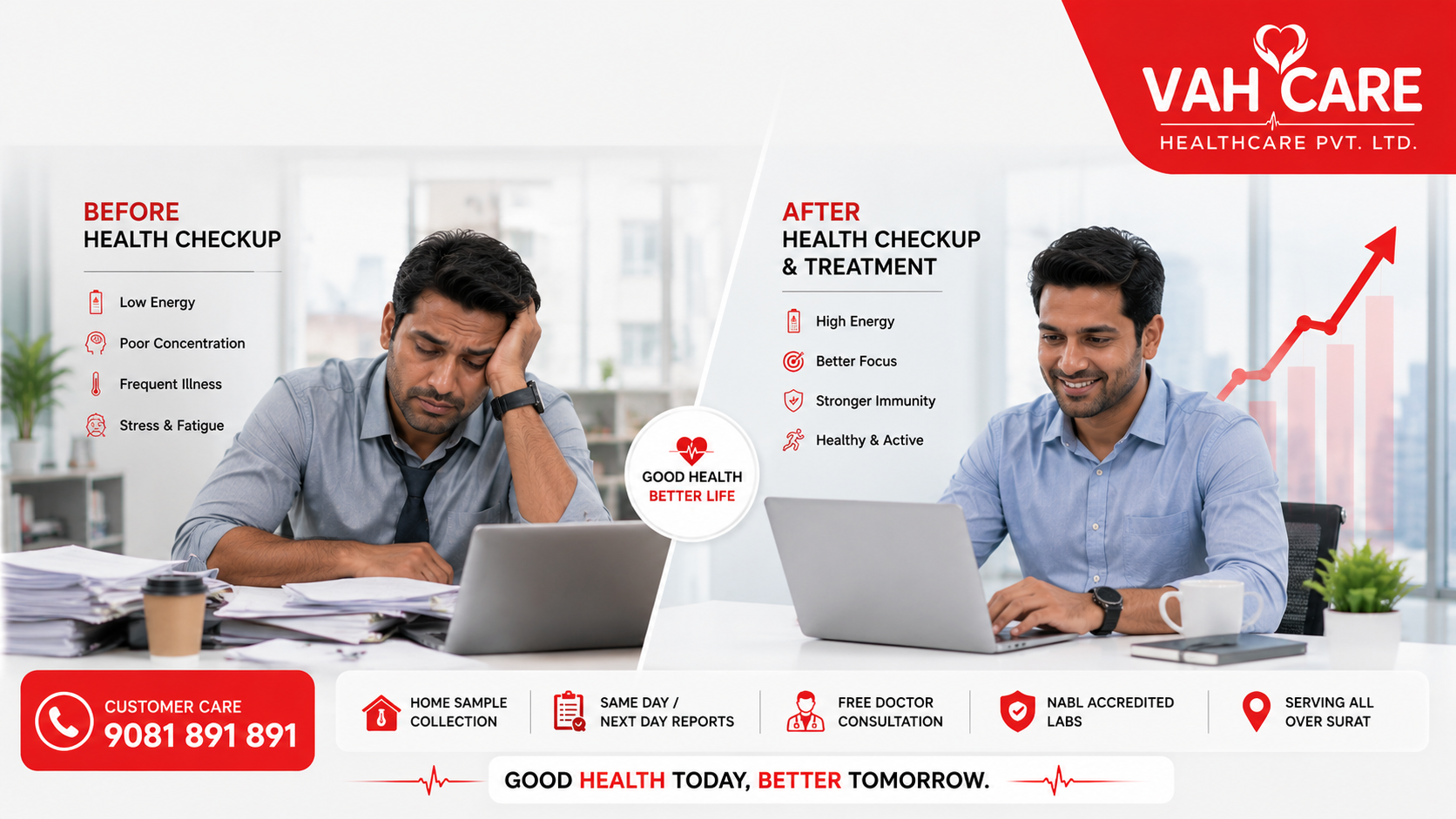
The Productivity Problem No Manager Talks About
In every business review in Surat — whether it is a textile exporter in Varachha, a diamond unit in Katargam, an IT company in Citylight, or a logistics firm near Sachin — the conversation eventually comes back to productivity. How do we get more output per hour worked? How do we reduce errors and rework? How do we retain our best people and keep them performing at their best?
These are questions of strategy, process, and culture. But there is a dimension of productivity almost never addressed in business reviews: the biological capacity of the people doing the work.
An employee managing undiagnosed hypothyroidism cannot think as quickly, concentrate as fully, or respond as flexibly to challenges as their thyroid-healthy colleague — regardless of their training, their motivation, or their experience. An employee with significant iron deficiency anaemia tires more quickly, recovers more slowly from physical or cognitive demands, and makes more errors in the hours after sustained effort. An employee with poorly controlled blood sugar has demonstrably worse working memory, slower information processing, and reduced impulse control compared to a metabolically healthy counterpart.
These are not character flaws. They are medical realities. And they are operating silently and invisibly in most Indian workforces — including those in Surat — because the conditions causing them are undetected, unmanaged, and therefore unaddressed.
This blog presents the evidence for the health-productivity link — the mechanisms by which specific health conditions directly degrade work performance — and explains how Vahcare Healthcare Pvt. Ltd.'s corporate health checkup programme turns this knowledge into measurable organisational benefit.
The Evidence: What Research Tells Us About Health and Productivity
The relationship between employee health and organisational productivity is one of the most robustly studied areas in occupational medicine. The findings are consistent, significant, and directly applicable to Indian organisations:
Absenteeism reduction: Research published in the Journal of Occupational and Environmental Medicine demonstrates that comprehensive corporate health screening programmes reduce employee sick days by an average of 28–32% over a two-year period. For an organisation with 100 employees averaging 6 sick days per year, this translates to approximately 900 recovered workdays annually.
Presenteeism cost: Multiple studies identify presenteeism — working while physically or cognitively impaired by illness — as costing organisations 2 to 3 times more than absenteeism in lost productive output. Unlike absenteeism (which is visible and tracked), presenteeism is invisible — the employee is at their desk, but their cognitive throughput is operating at 60–70% of their healthy baseline.
Return on investment: A systematic review by the Harvard Business Review found that companies investing in comprehensive employee wellness programmes generate average returns of $3.27 (approximately ₹275) for every dollar (approximately ₹84) invested — primarily through reduced absenteeism and healthcare cost reduction. Indian-context studies report similar or higher returns when accounting for the high prevalence of undetected conditions in the workforce.
Insurance cost impact: Organisations with documented wellness programmes and measurably healthier employee populations consistently report lower group health insurance premium escalation compared to industry benchmarks — with some reporting net premium stabilisation or reduction over three to five years of programme operation.
How Specific Health Conditions Impair Workplace Performance
Understanding the precise mechanisms by which common, detectable conditions degrade work performance makes the business case for corporate health screening concrete rather than abstract.
1. Thyroid Dysfunction — The Cognitive Thief
Hypothyroidism — an underactive thyroid gland — is one of the most common and most underdiagnosed conditions in Indian working adults, affecting an estimated 10–15% of the workforce, with significantly higher rates among women.
The productivity impact is direct and measurable:
The thyroid hormone (T3) is required for normal neurological function. T3 directly regulates the rate at which neurons process and transmit information. Hypothyroid individuals show measurable slowing in processing speed, working memory capacity, executive function, and attention sustained over time — the exact cognitive capacities most demanded by modern professional work.
Research on hypothyroid patients before and after treatment consistently demonstrates:
- Processing speed improvements of 15–25% after thyroid hormone normalisation
- Working memory improvements of 10–20%
- Significant improvements in mood, motivation, and fatigue that directly affect sustained effort
What this means for your organisation: An employee with undetected hypothyroidism is operating with a measurable cognitive handicap — slower to process complex information, more prone to errors, less able to sustain attention during demanding tasks. Treatment with once-daily thyroid hormone replacement tablet is inexpensive, highly effective, and normalises function within 6–12 weeks.
Detection requires one simple blood test: TSH (Thyroid Stimulating Hormone) — available through Vahcare's corporate health checkup programme.
2. Iron Deficiency Anaemia — The Energy Drain
Iron deficiency is the world's most prevalent nutritional deficiency, and Indian working women — particularly those of reproductive age — bear a disproportionate burden. But iron deficiency also significantly affects male employees, particularly in physically demanding roles.
How iron deficiency undermines productivity:
Haemoglobin carries oxygen from the lungs to every working tissue — brain, muscle, and organ. When haemoglobin is reduced (anaemia), every tissue receives less oxygen per heartbeat. The body compensates by increasing heart rate, but this compensation is metabolically expensive and has limits.
For knowledge workers and office professionals, the primary impact is cognitive: reduced oxygen delivery to the prefrontal cortex — the brain region responsible for planning, decision-making, working memory, and creative problem-solving — degrades the quality and speed of exactly the work these employees are paid to do.
For physically active employees (manufacturing, warehousing, logistics), the impact is additional: reduced aerobic capacity, faster fatigue, longer recovery between exertion periods, and higher injury risk from fatigue-related lapses in attention to safety.
Studies show: Iron-replete employees in physically demanding roles have 10–20% higher sustained work output compared to iron-deficient colleagues at equivalent training levels. Among knowledge workers, correction of iron deficiency produces measurable improvements in attention, processing speed, and accuracy within 8–12 weeks.
Detection: Complete Blood Count (CBC) with serum ferritin — standard components of all Vahcare health checkup packages.
3. Uncontrolled Hypertension and Cardiovascular Risk
High blood pressure affects an estimated 30% of Indian working adults and is directly associated with reduced cognitive function — a phenomenon called "hypertensive cognitive impairment" — even at pre-clinical levels before any obvious cardiac or neurological event.
The mechanism: Elevated blood pressure causes progressive damage to small blood vessels throughout the body — including those supplying the brain. Over years, this produces white matter changes (microscopic brain lesions) that degrade information processing speed, working memory, and executive function. These changes begin well before any stroke or clinically apparent neurological event.
Research shows that working adults with uncontrolled hypertension score measurably lower on cognitive assessments of memory, processing speed, and attention than age-matched normotensive controls — even without any prior cardiovascular events.
Additional productivity impact: Employees with uncontrolled hypertension are significantly more likely to experience sudden health crises requiring emergency hospitalisation — removing them from operation without warning, disrupting team function, and generating major insurance claims. Early detection and management prevents these events with straightforward, inexpensive intervention.
4. Diabetes and Blood Sugar Dysregulation
The brain runs on glucose — and its function is directly sensitive to blood sugar levels. Both hyperglycaemia (high blood sugar) and hypoglycaemia (low blood sugar — common with medication mismanagement) degrade cognitive performance acutely.
For employees with undetected or poorly managed diabetes:
- Chronic hyperglycaemia impairs hippocampal function (the brain region most critical for memory consolidation and learning)
- Post-meal glucose spikes cause the afternoon energy crash familiar to many office workers — a transient period of cognitive impairment that coincides with critical afternoon working hours
- Poor glucose control is associated with increased irritability and reduced emotional regulation — directly impacting teamwork, client interactions, and management quality
The productivity cost is substantial: Research in diabetic working populations shows 14–25% higher absenteeism rates, 40–50% higher short-term disability claim rates, and measurably lower performance ratings compared to non-diabetic colleagues in equivalent roles.
Detection: Fasting blood glucose and HbA1c — core components of Vahcare's corporate health checkup panel.
5. Vitamin D and B12 Deficiency — The Silent Underperformers
With 70%+ of urban Indians deficient in Vitamin D and near-universal B12 deficiency among vegetarian adults over time, these are the highest-prevalence conditions in most Surat workforces — and among the most overlooked contributors to reduced employee performance.
Vitamin D deficiency causes:
- Persistent fatigue and muscle weakness (directly reducing physical and cognitive stamina)
- Depressed mood and increased susceptibility to seasonal mood changes
- Impaired immune function (increasing sick day frequency)
- In research settings, measurable cognitive impairment at severe deficiency levels
Vitamin B12 deficiency causes:
- Progressive nerve damage producing concentration difficulties, memory impairment, and mood instability
- Megaloblastic anaemia (with all its associated cognitive and physical effects)
- In the early stages, the primary presentation is fatigue and "brain fog" — terms most managers attribute to overwork rather than a treatable nutritional deficiency
The productivity implication: A significant proportion of employees who appear to be disengaged, chronically tired, or underperforming may simply have correctable nutritional deficiencies. A Vitamin D and B12 test costs a few hundred rupees. The performance recovery from correction can be striking.
6. Chronic Stress and Cortisol-Mediated Impairment
Chronic psychological stress — endemic in Surat's high-pressure business environment — produces sustained cortisol elevation that has direct, measurable effects on brain function:
- Prefrontal cortex suppression: Chronic cortisol impairs the prefrontal cortex — reducing planning ability, decision quality, impulse control, and complex problem-solving
- Hippocampal damage: Prolonged cortisol elevation damages hippocampal neurons, directly impairing memory consolidation and learning
- Immune suppression: Sustained cortisol depresses immune function, increasing susceptibility to infection and extending recovery from illness
These effects compound over time — and they compound with the other conditions described above. An employee who is hypertensive, mildly anaemic, Vitamin D deficient, AND under chronic stress is not operating at a cumulative disadvantage — each condition amplifies the others.
The organisational intervention: Corporate health checkups that detect and correct physical health conditions directly reduce the physiological burden of stress response, even without changing work demands. An employee whose anaemia is corrected, whose thyroid is optimised, and whose Vitamin D is supplemented has measurably greater physiological resilience to workplace stress.
Quantifying the Cost to Your Organisation
For a concrete illustration, consider a hypothetical Surat-based textile exporter with 80 employees:
Based on Indian national health data, this workforce statistically includes:
- ~24 employees with undetected hypertension
- ~14 employees with undetected pre-diabetes or diabetes
- ~8–12 employees with clinically significant thyroid dysfunction
- ~56 employees with Vitamin D deficiency
- ~35+ employees with B12 deficiency (given vegetarian cultural prevalence in Surat)
- ~30–40 female employees with iron deficiency (if the workforce is mixed gender)
If each undetected, unmanaged condition costs the organisation an average of 4 additional sick days per year and 15% cognitive productivity reduction for that employee, the aggregate cost — in lost productive output, absenteeism, errors, and rework — runs to several lakh rupees annually.
A comprehensive corporate health checkup that detects and enables management of these conditions typically costs a fraction of this amount — with measurable productivity improvement beginning within 8–12 weeks of treatment initiation for most correctable conditions.
The Presenteeism Problem: The Invisible Cost
Presenteeism deserves particular emphasis because it is the more expensive and less visible counterpart to absenteeism — yet almost no Indian organisation tracks or manages it.
When an employee with undetected hypothyroidism sits at their desk, they are "present." Their attendance record shows no absence. But their cognitive output — the quality and speed of their thinking, their ability to sustain concentration, their creative problem-solving — is operating at perhaps 75–80% of their healthy baseline.
For a senior employee earning ₹60,000 per month, operating at 80% cognitive capacity costs the organisation the equivalent of ₹12,000 per month in lost value — every month the condition goes undetected. Over 18 months of undetected hypothyroidism, the cumulative presenteeism cost to the organisation exceeds ₹2 lakh — far more than the cost of a comprehensive health checkup that would have identified the condition.
The same logic applies to anaemia, Vitamin D deficiency, poorly controlled diabetes, and every other condition that impairs cognitive and physical capacity while leaving the employee technically "at work."
The Talent Retention Connection
In Surat's competitive employment market — where skilled diamond cutters, textile technicians, software developers, and logistics managers are actively recruited by competing organisations — employee retention is a significant operational priority.
Research consistently identifies perceived employer care and support as a key driver of employee loyalty and retention. Among the most tangible and valued expressions of this care: investment in employee health.
A structured corporate health checkup programme sends a clear, credible signal: this organisation values me as a person, not just as a resource. In exit interview research across Indian industries, lack of perceived care for employee wellbeing consistently ranks among the top five reasons employees leave — alongside compensation and career growth.
Conversely, organisations with visible, well-implemented wellness programmes report:
- 18–25% lower voluntary turnover rates compared to industry peers
- Higher employer brand scores on platforms like Glassdoor and LinkedIn
- Stronger internal referral rates (employees who feel cared for recommend the organisation to people they know)
For an organisation that spends ₹2–5 lakh training a skilled employee over 12–18 months, retaining that employee for an additional two to three years through meaningful wellness investment represents a substantial return on a relatively modest programme cost.
Implementing a Productivity-Focused Corporate Wellness Strategy With Vahcare
A corporate health checkup programme with Vahcare Healthcare Pvt. Ltd. is the foundation of a productivity-focused wellness strategy. Here is how Surat organisations can implement it effectively:
Step 1: Establish a Health Baseline Commission a comprehensive corporate health checkup through Vahcare for your entire workforce. Receive anonymised aggregate health data that reveals the specific conditions most prevalent in your employee population — guiding targeted follow-up interventions.
Step 2: Enable Follow-Through The checkup is valuable only if employees can act on findings. Create policies that allow flexible time for follow-up medical appointments. Partner with Vahcare for ongoing home collection for employees managing chronic conditions that require regular monitoring.
Step 3: Address Environmental Risk Factors Use aggregate data insights to make workplace environment decisions: healthier canteen menus if blood sugar is a concern, improved ventilation and lighting if Vitamin D access is limited by indoor working conditions, stress management resources if hypertension prevalence is high.
Step 4: Annual Programme Continuity Commit to an annual corporate health checkup cycle. Year-on-year comparison of aggregate health data demonstrates programme impact, shows improvement in managed conditions, and maintains the cultural signal of organisational care for employee wellbeing.
Step 5: Connect to Business Metrics Track correlations between programme participation and business metrics: absenteeism rates, error rates, employee performance ratings, and insurance claim experience. This data builds the business case for continued and expanded programme investment.
Prevention Tips: Supporting Employee Health Beyond the Annual Checkup
Workplace nutrition: The food available at your workplace directly affects employee blood sugar, energy, and cognitive performance through the workday. Replacing refined carbohydrate snacks (biscuits, white bread) in meeting rooms with lower-glycaemic alternatives (nuts, seeds, fruit, makhana) produces measurable improvements in afternoon cognitive performance without requiring any individual behaviour change.
Movement integration: Sedentary office work directly worsens insulin resistance, blood pressure, and musculoskeletal health. Policies that normalise standing, walking meetings, and brief movement breaks — even a 5-minute walk every 45–60 minutes — produce measurable improvements in afternoon energy and concentration for most employees.
Sleep culture: Normalising a culture where sustainable working hours and adequate sleep are valued — rather than glorifying chronic overwork — produces measurable reductions in absenteeism, medical claim rates, and management errors. Leadership behaviour is the single most powerful determinant of team sleep culture.
Stress management resources: Access to mindfulness apps, yoga or meditation sessions, or confidential counselling services directly reduces the cortisol-mediated cognitive impairment that chronic workplace stress produces. These interventions are inexpensive relative to their productivity impact.
Frequently Asked Questions (FAQs)
Q1. How quickly will we see productivity improvement after a corporate health checkup programme? Improvements from treating detected conditions begin within weeks. Thyroid treatment produces measurable cognitive improvement in 6–12 weeks. Iron supplementation for anaemia begins producing energy improvement in 4–6 weeks. Vitamin D and B12 correction shows improvement in 6–8 weeks. At the organisational level, aggregate productivity indicators typically show measurable improvement within 3–6 months of programme implementation and treatment initiation.
Q2. How do we measure the productivity impact of our corporate health programme? Track: (1) Absenteeism rate (sick days per employee per year, before vs after programme); (2) Insurance claim frequency and value; (3) Optional employee self-reported energy, focus, and health satisfaction surveys; (4) Manager-reported performance indicators for employees who disclose treatment. Vahcare can provide programme health outcome reports to support this measurement.
Q3. What if employees are unwilling to participate in a corporate health checkup? Participation is always voluntary at Vahcare. Communication that emphasises individual health benefit, confirms confidentiality of results, and features leadership participation (when directors and managers openly participate, others follow) typically achieves participation rates of 70–85% in first-year programmes, rising to 85–95% by the second and third year as employees experience the benefit.
Q4. We have a predominantly female workforce in our garment unit. What specific conditions should we screen for? Vahcare's Women's Health Checkup package includes expanded screening for iron deficiency (CBC with ferritin), thyroid function, Vitamin D and B12, and diabetes — the four most prevalent and most productivity-impairing conditions in female workforces. Contact Vahcare on 9081 891 891 to design a programme tailored to your workforce demographics.
Q5. Our employees work in shifts and cannot all attend an on-site camp. How does Vahcare accommodate this? Vahcare's home collection service covers all of Surat, with early morning slots from 6 AM available for employees completing night shifts or those who prefer home testing. The home collection format is ideal for shift-based workforces — each employee books individually at their preferred time, with no requirement to attend a fixed camp.
Q6. Can a corporate health programme help us reduce our group health insurance premiums? Yes, over time. Group insurance premiums are calculated on claims experience. A workforce with proactively managed chronic conditions generates fewer and less expensive claims. Most Indian insurance providers formally recognise documented corporate wellness programmes in their premium calculations. Discuss with your insurance broker how to formally document Vahcare's programme for premium negotiation purposes.
Q7. How is employee data handled? Can we as employers access individual employee health results? Individual results are strictly confidential — they go only to the employee directly. Employers receive only anonymised, aggregate population health reports (for example, "42% of your workforce has Vitamin D deficiency" — without naming individuals). This privacy framework is legally and ethically essential and is fundamental to Vahcare's corporate programme design.
Q8. What does the Vahcare corporate health checkup programme cost per employee? Corporate pricing is based on the package selected, programme format (on-site or home collection), and total employee count. Group programmes receive significant volume discounts compared to individual test rates. Contact Vahcare's corporate team on 9081 891 891 for a customised proposal with per-employee pricing for your organisation's size and requirements.
Conclusion: Invest in Your People's Health — and Watch Your Business Perform Better
The connection between employee health and business productivity is no longer a soft HR argument — it is a hard financial reality, backed by decades of occupational medicine research and quantifiable in every meaningful business metric.
In Surat's competitive business environment, the organisations that will build sustainable productivity advantages are those that recognise their workforce's biological capacity as a manageable business variable — not a fixed, uncontrollable background condition.
Thyroid disorders that can be corrected with a daily tablet. Anaemia that can be reversed with supplementation. Vitamin deficiencies that cost a few hundred rupees to detect and correct. Blood pressure that responds to simple lifestyle changes and inexpensive medication. These are not complex, expensive, or difficult interventions. They are straightforward solutions to documented, detectable problems — problems that are costing your organisation in lost productive output, absenteeism, errors, and talent attrition every single day they go unaddressed.
Vahcare Healthcare Pvt. Ltd., Surat offers the corporate wellness solution that Surat's best employers are adopting — comprehensive, clinically rigorous, logistically seamless health screening for organisations of every size, across all of Surat, with same-day reports, doctor consultations, and the aggregate health insights needed to turn a one-day screening event into a sustained organisational health strategy.
Your team's health is your business's most underinvested asset. Invest in it.
📞 Call 9081 891 891 to design Vahcare's Corporate Health Checkup Programme for your organisation. All Over Surat | On-Site Camps | Home Collection | Same Day Reports | Group Pricing | Doctor Consultation Included